
Let's be real for a second. The way most of us are building stuff today is honestly insane. You’ve got Vercel for frontend, Railway for backend, AWS S3 for storage, PlanetScale for your database, Redis Labs for cache, Cloudinary for images… and suddenly you’re paying FIVE DIFFERENT COMPANIES just to keep your half-baked side project alive.
And the worst part? Half of these services overlap each other. Half of them lock you in. And all of them start cheap and slowly turn into monthly subscriptions that feels like renting your own code. You don’t even realize when it happens. One day it’s free tiers, the other day it's subscriptions.
The Cloudflare Advantage
Cloudflare is out here basically begging developers to just use their ecosystem. Workers for backend. Pages for frontend. R2 for storage (without any fees, which is insane). D1 for databases. KV for fast key-value storage. Durable Objects for real-time stuff. Queues. Workflows. Even AI and vector databases with Vectorize.
All of this, on One platform. One dashboard. One bill. And honestly, one of the most generous free tiers you’ll ever see.
Like think about it. You can literally build a full-stack production app without touching AWS, without configuring 10 dashboards, without stitching together services like you’re building a Frankenstein system.
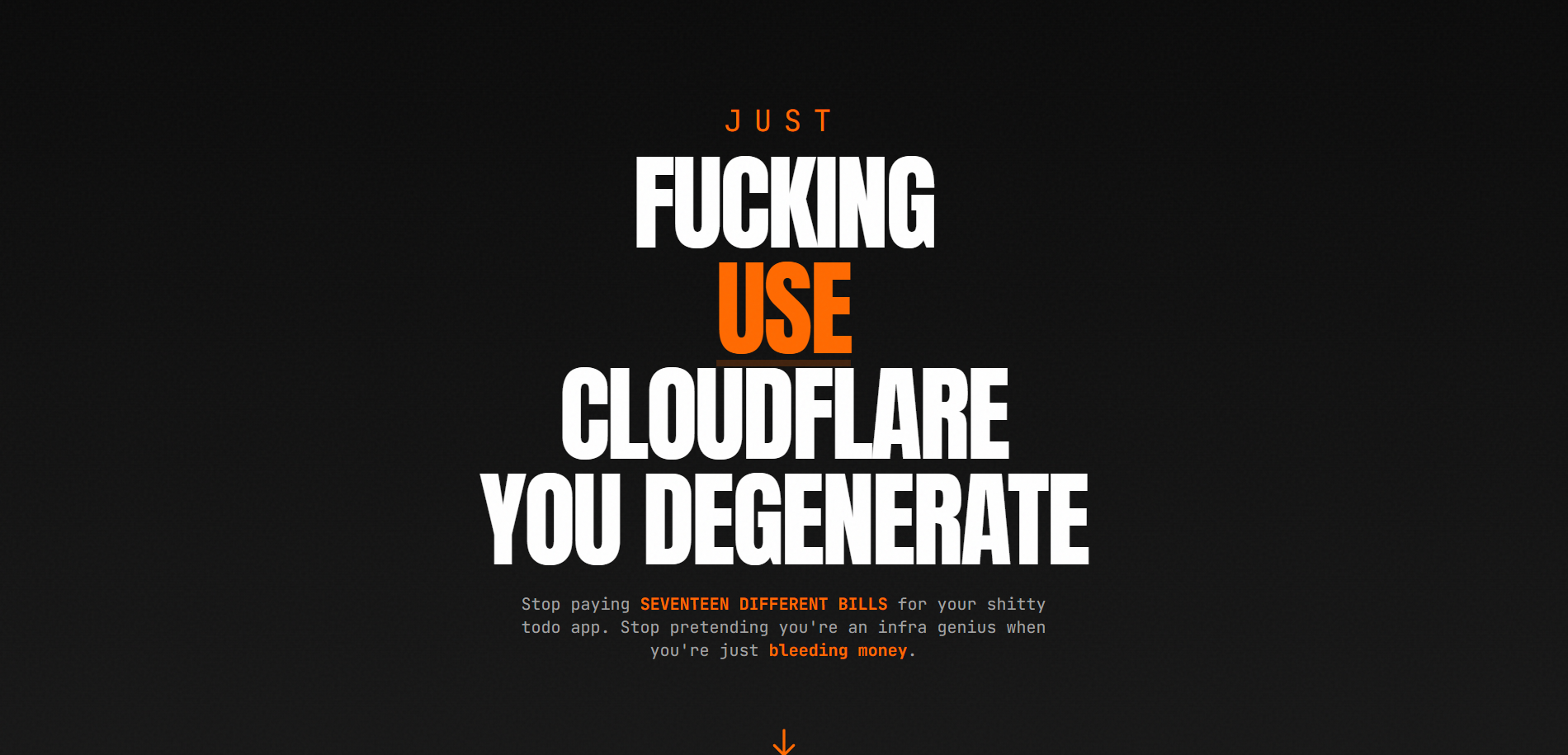
"https://justfuckingusecloudflare.com/"
Why This Matters More Than You Think
When you use 5 different platforms, you’re not just paying money, you’re paying with complexity. Debugging becomes harder. Scaling becomes messy. Costs become unpredictable. And onboarding someone to your project feels like explaining a startup pitch deck instead of just showing code.
Cloudflare flips that. It’s edge-first, globally distributed by default, insanely fast, and surprisingly simple once you get used to it. You don’t think about regions, CDNs, or infra headaches, it’s already handled.
Cloudfare Is Not Perfect
I’m not saying Cloudflare is perfect. It has its own quirks. Workers runtime is different from traditional Node. Some libraries don’t work out of the box. Debugging can feel weird at times. And yes, the ecosystem is still evolving.
But here’s the thing, these are learnable problems. Over time, you adapt. And once you do, you realize the trade-off is worth it.
The Bigger Bet
At the end of the day, you’re betting on infrastructure. And Cloudflare is not some random startup that’s going to disappear tomorrow. They run a massive part of the internet already. Performance, security, global edge, that’s literally their DNA.
So instead of juggling five corporate overlords and praying your stack doesn’t break, you can just, simplify it.
Conclusion
If you’re just starting something new, at least consider going all-in on Cloudflare once. Build a project fully inside it. Understand it. Break it. Fix it. You’ll come out way sharper as a developer.
Because honestly? The future is not about stacking more services. It’s about removing unnecessary ones. And Cloudflare might be the closest thing we have right now to that idea actually working.