
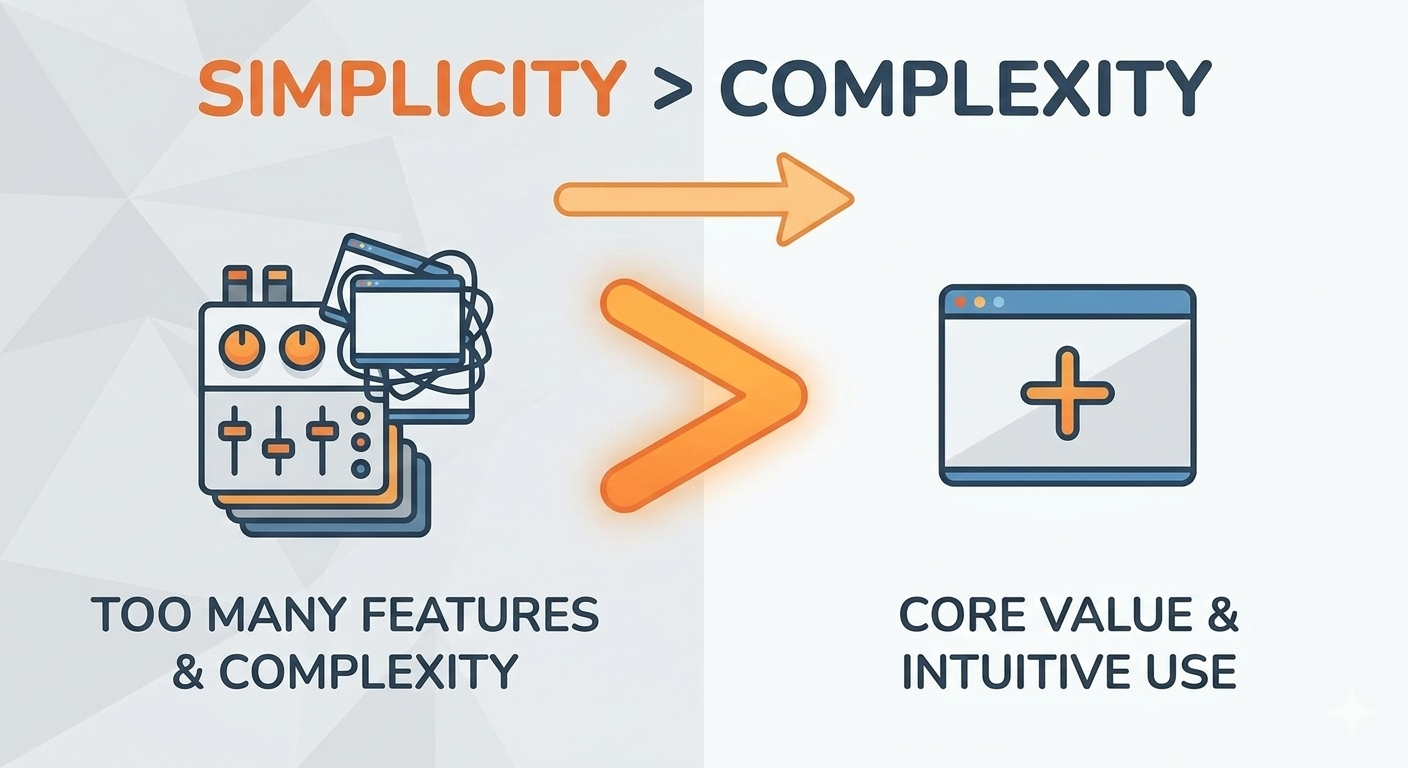
I really believe simplicity wins in software, and the more I see products around me, the more strongly I feel this. A lot of people think adding more and more features makes software better. On the surface, that sounds smart. More options, more power, more settings, more flexibility. But in reality, that is not always what users want. A lot of the time, users just want something that works well, feels easy, and solves the problem without making their life harder.
That is the main point for me. If your product starts becoming so complicated that it creates a new problem while trying to solve an old one, then something has gone wrong. The whole point of software is to make things easier, faster, clearer, or more accessible. If the user comes into your product and feels confused, overloaded, or mentally tired, then your product is not really helping the way it should.
More Features Does Not Always Mean Better Product
I think one of the biggest traps in software is feature obsession. Builders start with a good idea, then slowly begin adding everything they can think of. One more tab. One more setting. One more panel. One more control. One more little advanced thing. And before they know it, the product is crowded. The clarity is gone. The purpose becomes blurry. The user no longer knows what matters most.
I understand why this happens. When you build something, it is easy to feel like more work means more value. It feels like if you keep adding things, people will be more impressed. But most users do not judge products that way. They judge by experience. They judge by whether it feels intuitive. They judge by whether they can get what they want without effort.
That is why simple products often feel stronger. They are easier to understand. Easier to trust. Easier to return to. Easier to recommend. When the user understands your product quickly, that is powerful. It means your product communicates clearly.
"If your product creates a problem for your solution, then that solution is already failing."
That is really how I see it. Simplicity is not about making things look empty or basic. It is about removing unnecessary friction. It is about focusing the user on what matters. It is about respecting their attention. People already deal with enough noise every day. Good software should reduce that noise, not add to it.
Simple Does Not Mean Easy to Build
What makes simplicity so interesting is that it is actually harder than complexity in many cases. Anybody can keep adding things. That part is easy. The difficult part is deciding what to remove. The difficult part is choosing what not to build. The difficult part is reducing something until only the meaningful parts remain.
That takes clarity. It takes product understanding. It takes confidence. Sometimes teams keep extra features in a product because they are scared to commit to a simpler path. They want to please everyone. They want every possible use case covered. But in trying to serve everyone, they end up making the product worse for the people who matter most.
I think the best products usually solve one thing really well first. They do not try to become everything on day one. They earn trust through clarity. Then, if they grow, they grow in a way that still protects the core experience.
Even in UI design, simplicity is powerful. Clear spacing, strong hierarchy, fewer distractions, obvious actions, clean navigation, and understandable flow all make a huge difference. Users should not need to think too much about how to use your interface. The interface should feel natural. If someone needs a guide just to understand the basics, that is already a bad sign.
Simplicity in Code and Architecture Matters Too
This idea does not only apply to the user side. It matters in code and system design too. I think developers sometimes forget that the product experience is not the only place complexity becomes dangerous. Bad structure behind the scenes can slowly destroy a project as it grows. Messy architecture, over engineered abstractions, unclear file structure, too many moving parts, and unnecessary technical cleverness can make a codebase painful very quickly.
Simple systems are easier to maintain. Easier to debug. Easier to explain. Easier for other developers to work with. If somebody new joins the project, they should not feel like they are entering a maze. They should be able to understand the structure without fighting it.
I think some developers confuse complexity with intelligence. They build things in a way that looks advanced but is actually harder to manage. For me, real skill is making something powerful without making it messy. Real skill is making complicated things feel clean.
And this matters even more over time. Complex systems become slower to change. Small updates become bigger than they should be. Bugs become harder to trace. Teams spend more time understanding the structure than improving the product. Simpler systems tend to age better because they are easier to reason about.
That is why I feel simplicity is not just a design choice. It is a long term strategy. A simple product is easier to use. A simple system is easier to scale. A simple codebase is easier to improve. A simple experience is easier to love.
Of course, not every product can be extremely minimal. Some products are naturally complex because the problem itself is complex. But even then, the goal should still be clarity. The goal should still be to hide unnecessary complexity from the user and organize necessary complexity in the best way possible.
In the end, I think simplicity wins because people value ease more than they admit. Users remember how a product made them feel. If it felt smooth, they come back. If it felt frustrating, they leave. It is that simple. So when I think about software, I always come back to this idea: do not build something that makes the solution harder than the problem. Keep it clear. Keep it useful. Keep it human.